 PlinthStart building
The baseYourbillingStands on.
Recurring billing & reconciliation, built for how Nigeria actually pays.
The problem
Recurring payments in Nigeria are leaky and manual.
01
Charges fail
Most recurring card charges in Nigeria don’t go through.
02
Reconciled by hand
Matching inbound transfers to customers is slow and manual.
03
Slips away
Failed charges churn silently; deposits go untracked.
Plinth Subscriptions · the billing engine
Billing that recovers what others lose.
A managed recurring-billing layer on Nigerian rails. Plinth collects, retries, and reconciles — so revenue actually lands.
Transfer-native dunning
Smart, payday-aware retries recover payments that fail — and most card charges in Nigeria do.
Cards, fully supported
A complete, conventional card experience too — first-class, not an afterthought.
Proration & plan changes
Upgrades, downgrades, prepaid and postpaid billing, prorated to the kobo.
Entitlements API
Tells your product who currently has access, so you can gate features cleanly.
Plinth Accounts · the foundation
And the foundation it's built on.
Dedicated virtual accounts with automatic reconciliation — the base the billing engine runs on, useful on its own too.
A dedicated account number per customer
Every customer gets their own virtual account — so money arrives already attributed.
Automatic reconciliation
Inbound transfers reconcile themselves: exact, partial, overpayment, or unidentified.
Statements & a running ledger
Per-customer statements and a transparent, double-entry ledger you can trust.
Standalone-capable
Use it on its own, or as the solid base beneath Plinth Subscriptions.
How it works
Three steps to recurring revenue.
- 01
Create a plan
Define pricing and interval — e.g. ₦5,000/month. Presets or granular policy, your call.
- 02
Subscribe a customer
Attach a customer to the plan. They get a dedicated account; cards work too.
- 03
Plinth does the rest
It collects, retries, reconciles, and tells your product exactly who has access.
The differentiator
Built for how Nigeria actually pays.
Cards fail often here; bank transfer rarely does. Plinth is transfer-native, so it defaults to the rail that works and falls back to it when cards die.
0%
Recurring card charges that fail
0%
Transfers that clear first try
+0%
Revenue recovered by smart dunning
Who builds on PlinthOne base,
One base,
many businesses.
If you collect on a schedule, Plinth carries the hard part.
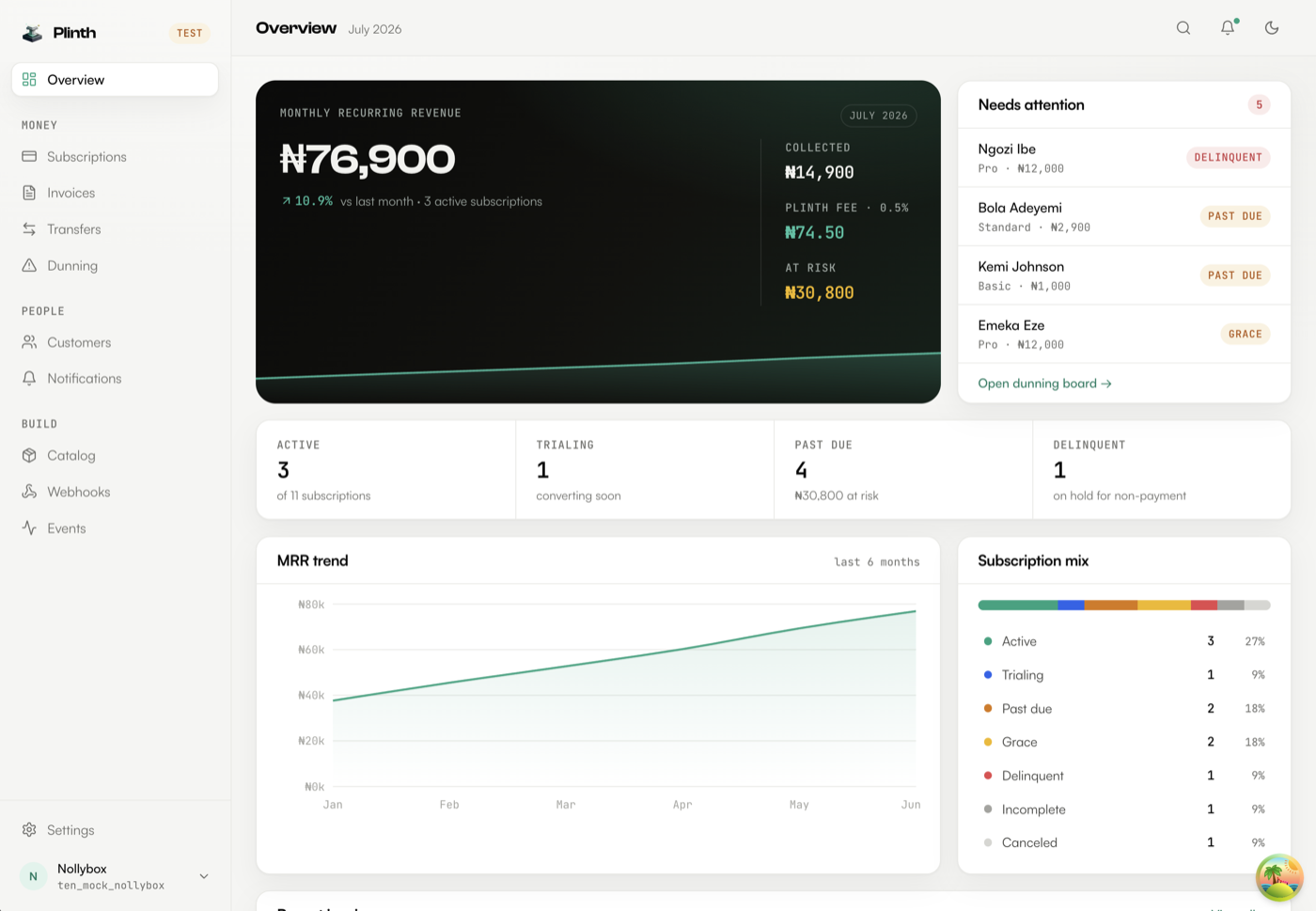
SaaSProduct UI
Streaming
Plan picker: Basic, Pro, Family. Upgrades mid-flow, prorated to the kobo.
Cooperative · ajo / esusu
School

Any business
Developer experience
Integrate in a few lines.
Drop Plinth in; don't rebuild billing. A clean API, SDKs, and webhooks. Money-critical correctness, handled for you.
- Clean REST API
- Typed SDKs
- Webhooks for every event
- Idempotent by design
subscribe.ts
import { Plinth } from "@plinth/sdk";const plinth = new Plinth(process.env.PLINTH_API_KEY); // 1. Define a plan (₦5,000/month, amounts are in kobo)const plan = await plinth.plans.create({ name: "Pro", amount: 500_000, interval: "monthly",}); // 2. Subscribe a customerconst sub = await plinth.subscriptions.create({ customer: "cus_bob", plan: plan.id,}); // 3. Ask who has access; your product gates on thisconst access = await plinth.entitlements.get("cus_bob");// → { active: true, features: ["pro"], valid_until: "2026-07-25" }200 OKentitlements resolvedaccess granted
Correctness & trust
Money-critical, by default.

Double-entry ledger
Every movement is recorded twice and balances exactly. Kobo-precise money math you can audit.
Idempotent by design
Retries and webhooks can't double-charge or double-count. Safe to call again.

Every kobo reconciled
Exact, partial, overpayment, unidentified — each inbound transfer is accounted for.

Built on Nomba's rails
Settlement and movement run on regulated, production payment infrastructure.
Security & compliance details (encryption, access controls, certifications) — placeholder, to be finalised before launch.
Pricing
Start free. Pay as you grow.
Transparent, usage-based pricing — final rates published at launch.
Growth
Most popularUsage-based
Go live and scale
- Everything in Sandbox
- Live transfers & cards
- Smart, payday-aware dunning
- Reconciliation & ledger
- Email support
Enterprise
Custom
Volume, controls & SLAs
- Everything in Growth
- Volume pricing
- Dedicated support & SLA
- Custom policy & onboarding
Social proof
What builders will say.
Placeholder quote — a customer describes how Plinth recovered revenue and removed the manual reconciliation work.
Name, Role
Company
Placeholder quote — a customer describes how Plinth recovered revenue and removed the manual reconciliation work.
Name, Role
Company
Placeholder quote — a customer describes how Plinth recovered revenue and removed the manual reconciliation work.
Name, Role
Company
FAQ
Questions, answered.
Recurring-payments infrastructure for Nigeria. It handles subscriptions, recurring billing, and automatic reconciliation so you don't have to build billing from scratch.
Plinth runs on Nomba's payment rails. You integrate with Plinth; the underlying settlement is powered by Nomba.
Both, fully. Plinth is transfer-native because transfers clear reliably in Nigeria, with first-class card support and an automatic card → transfer fallback.
Each customer gets a dedicated account number, so inbound transfers arrive already attributed. Plinth matches exact, partial, overpayment, and unidentified payments automatically.
A few lines with the SDK to create a plan, subscribe a customer, and read entitlements. Clean API, webhooks, and idempotency are built in.
Start free in sandbox. Live usage is usage-based, with custom pricing for volume. Final rates are published at launch.

Get started
Build on Plinth.
Your product is the column. Plinth is the base it stands on — recurring payments, on solid ground.